NEWSLETTER
Why Your Best Innovation Champion Will Fail in the Wrong Culture — No Matter How Smart or Passionate They Are
New peer-reviewed research reveals the hidden mechanism that either amplifies or neutralizes the very people your organization needs most.

PART 1 — THE PROBLEM
Most Innovation Strategies Die Before Implementation
Not because the ideas are weak. Not because the funding ran out.
Because the person championing the idea lacked the emotional wiring to navigate institutional resistance — and the cultural terrain was stacked against them from the start.
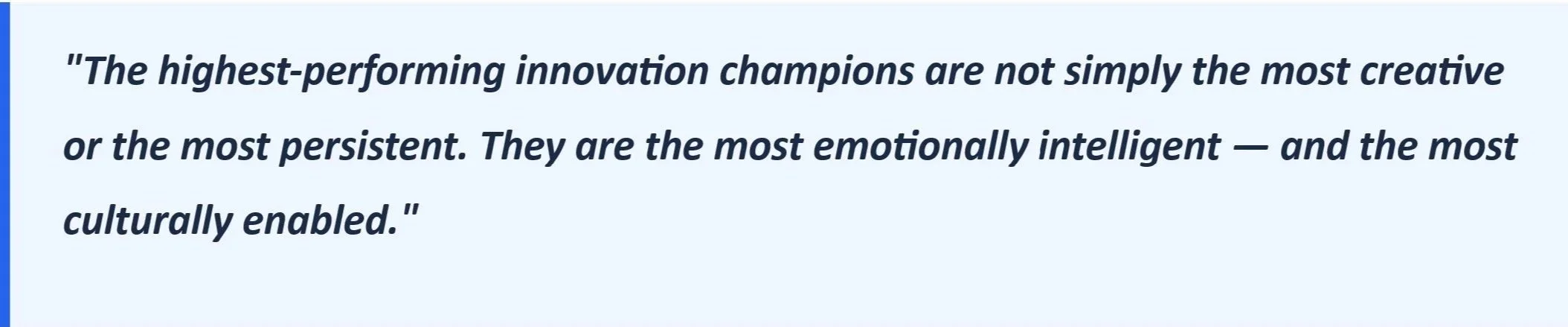
Organizations invest billions in innovation pipelines, R&D infrastructure, and ideation programs. Yet study after study shows that execution failure — not idea failure — is the primary culprit behind stalled transformation.
The reason, it turns out, is deeply human. And measurable.
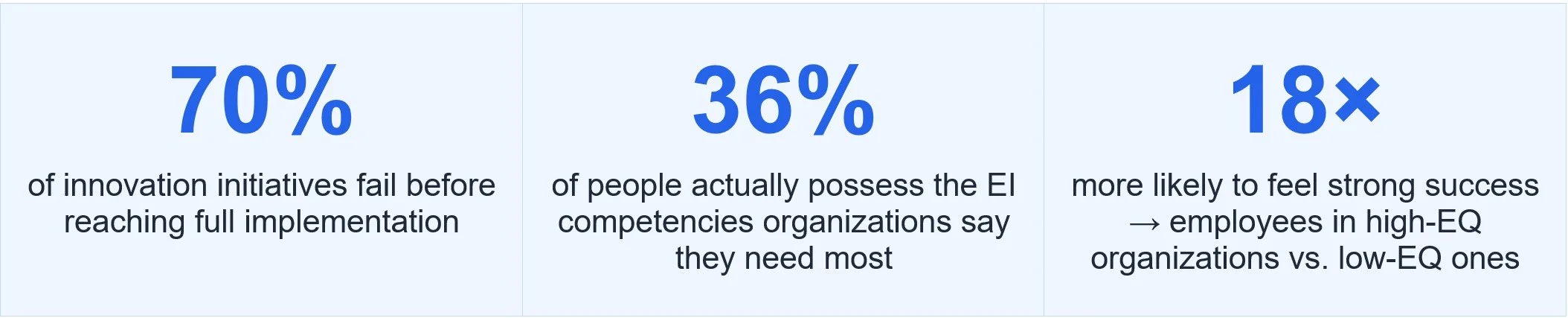
Sources: McKinsey & Company (2024); World Economic Forum Future of Jobs Report (2023); O.C. Tanner 2025 Global Culture Report
The Harvard Business Review has long argued that a leader's emotional intelligence isn't a "soft" advantage — it's the hidden engine of organizational performance. As Goleman, Boyatzis, and McKee showed, emotional intelligence improves results often by an order of magnitude, and a leader's mood and emotional presence serve as the primary lever through which culture and performance are shaped. Harvard Business Review
👉 Read the full HBR article here: Primal Leadership: The Hidden Driver of Great Performance
Now, new peer-reviewed research takes that insight further — and gets specific about why culture changes everything.

PART 2 — THE ACADEMIC SOURCE
What a New 2026 Study Found — and Why It Changes the Conversation

Published in the International Journal of Innovation Studies in March 2026, this peer-reviewed study examined the relationship between emotional intelligence (EI), innovation championing behavior, and cultural context across organizations spanning multiple national and institutional settings.
Their core finding is deceptively simple — but its implications are profound:
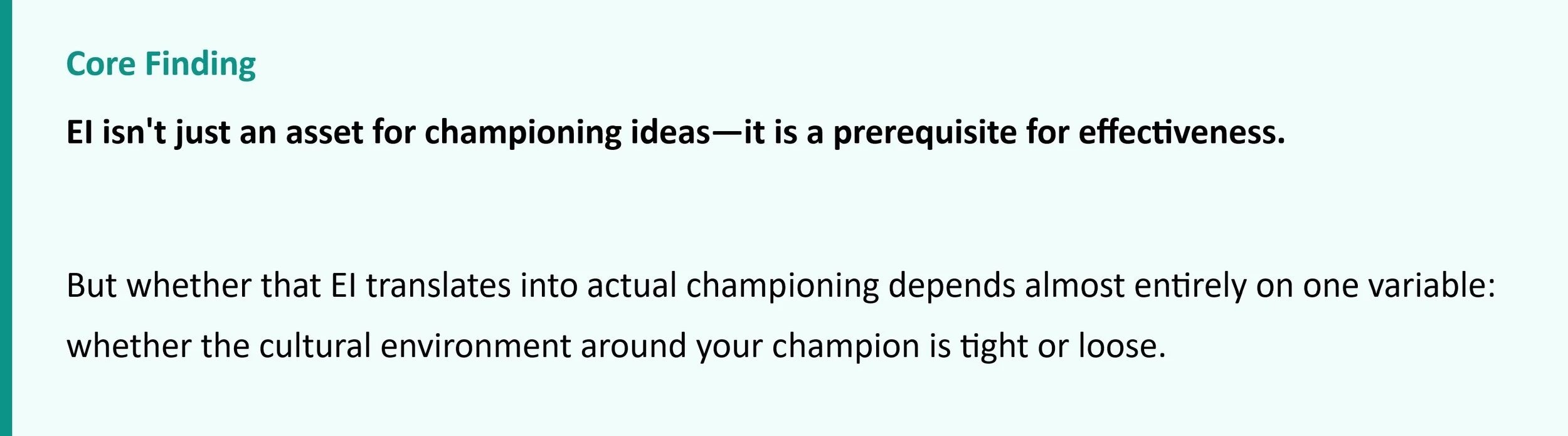
Champions who score high on self-awareness, empathy, and emotional regulation are significantly more likely to advocate persistently for innovative ideas under resistance. But the cultural environment determines whether that advocacy is amplified — or quietly suppressed.
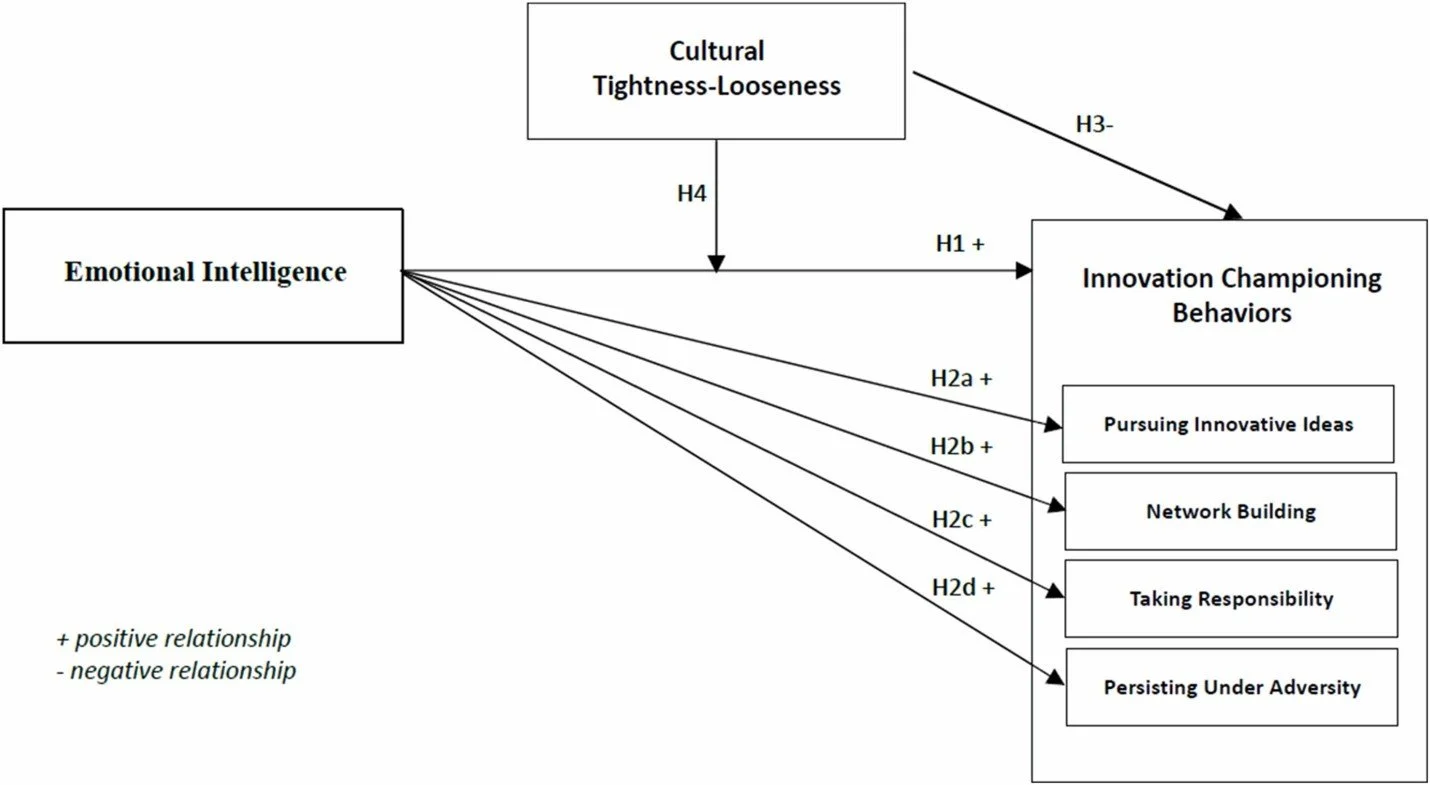
Conceptual Model: EI → Innovation Championing Behavior, moderated by Cultural Tightness-Looseness (Lutfiyya et al., 2026)
This reinforces what HBR's foundational work on "Primal Leadership" established more than two decades ago: that a leader's emotional resonance is the hidden driver of organizational performance. The Lutfiyya et al. study now specifies exactly where that dynamic lives — in the space between individual EI and organizational culture.
Read the original HBR anchor: Primal Leadership: The Hidden Driver of Great Performance — Goleman, Boyatzis & McKee, Harvard Business Review
What the data actually shows:
EI is an antecedent to innovation championing behavior — not just a leadership nicety. Champions who score high on self-awareness, empathy, and emotional regulation are significantly more likely to advocate persistently for innovative ideas under resistance.
Cultural tightness suppresses the EI → championing link. In rigid, norm-heavy environments, even high-EI individuals pull back. The culture "tightens the ceiling" on what emotional intelligence can unlock.
Cultural looseness amplifies it. In psychologically flexible, deviation-tolerant cultures, high EI supercharges championing behavior. The same person, with the same skills, performs dramatically differently depending on cultural context.
PART 3 — THE TRANSLATION
3 Practical Things the Research is Telling You
Here is the Lutfiyya et al. framework translated into plain language — with direct implications for how your organization is structured today.
1. EI Is the Engine. Championing Is the Output.
Emotional intelligence — specifically the ability to perceive, regulate, and apply emotions strategically — is what gives a champion the staying power to push through organizational inertia. Without it, even the best ideas stall at the first sign of resistance.
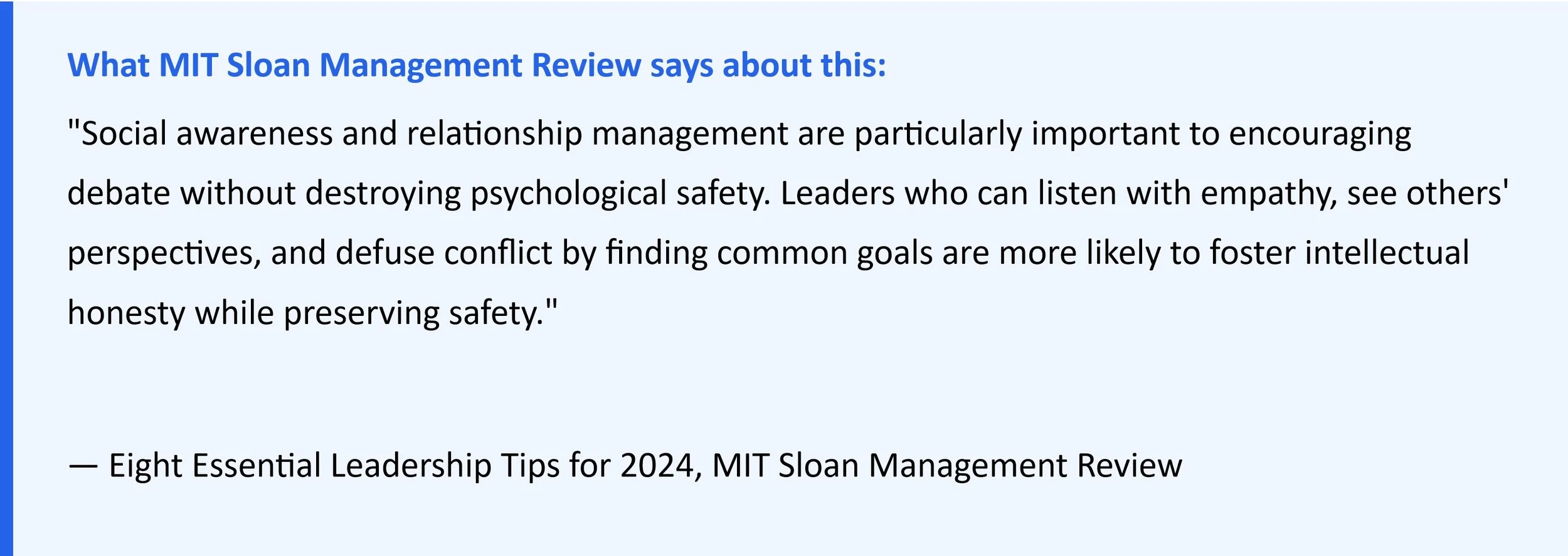
This is not about personality or charisma. It is about four specific competencies: self-awareness, self-regulation, social awareness, and relationship management.
2. Culture Is the Ceiling — or the Accelerant.
In tight cultures — those characterized by strong norms, low tolerance for deviation, and high conformity pressure — even high-EI individuals pull back. The culture effectively caps what emotional intelligence can unlock.
In loose cultures — flexible, experimentation-tolerant, psychologically safe — the same EI profile produces dramatically more championing behavior. The same person performs at a categorically different level.
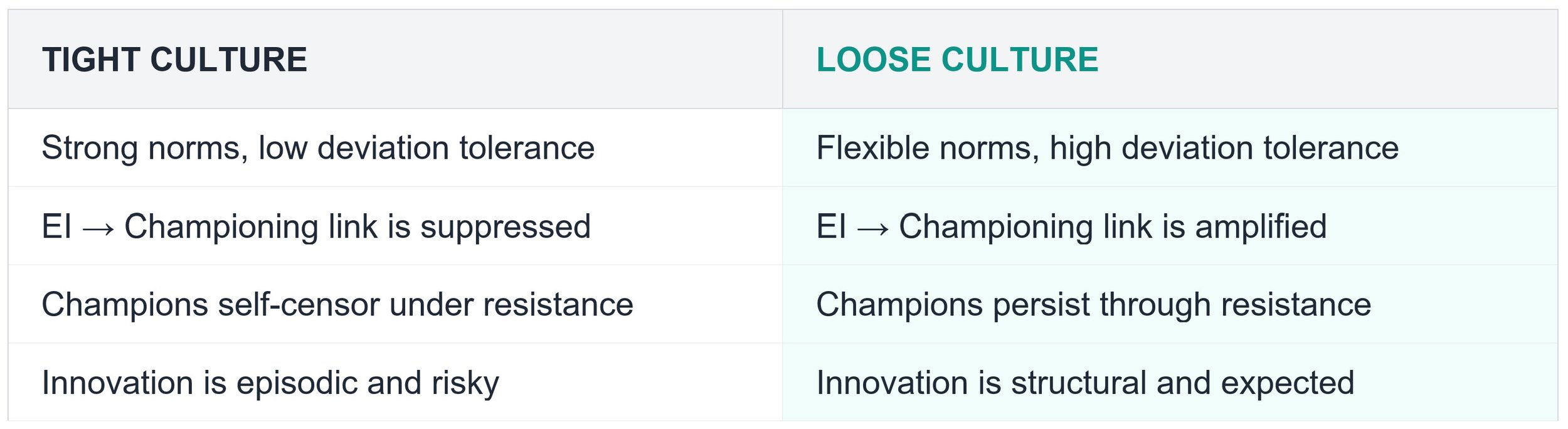
Cultural tightness-looseness framework applied to innovation championing behavior — adapted from Lutfiyya et al. (2026)
3. Cross-Cultural Contexts Multiply the Complexity.
For organizations operating across national cultures, merged entities, or matrixed global teams — the cultural tightness-looseness variable isn't a single dial. It's a different dial in every country, function, and team.
This means that your innovation pipeline is only as strong as the weakest cultural link in the chain. A champion who thrives in your London office may be systematically neutralized in your Seoul or Riyadh operations — not because they are less capable, but because the cultural container is different.
PART 4 — THE APPLICATION
What You Can Do With This — Starting Immediately
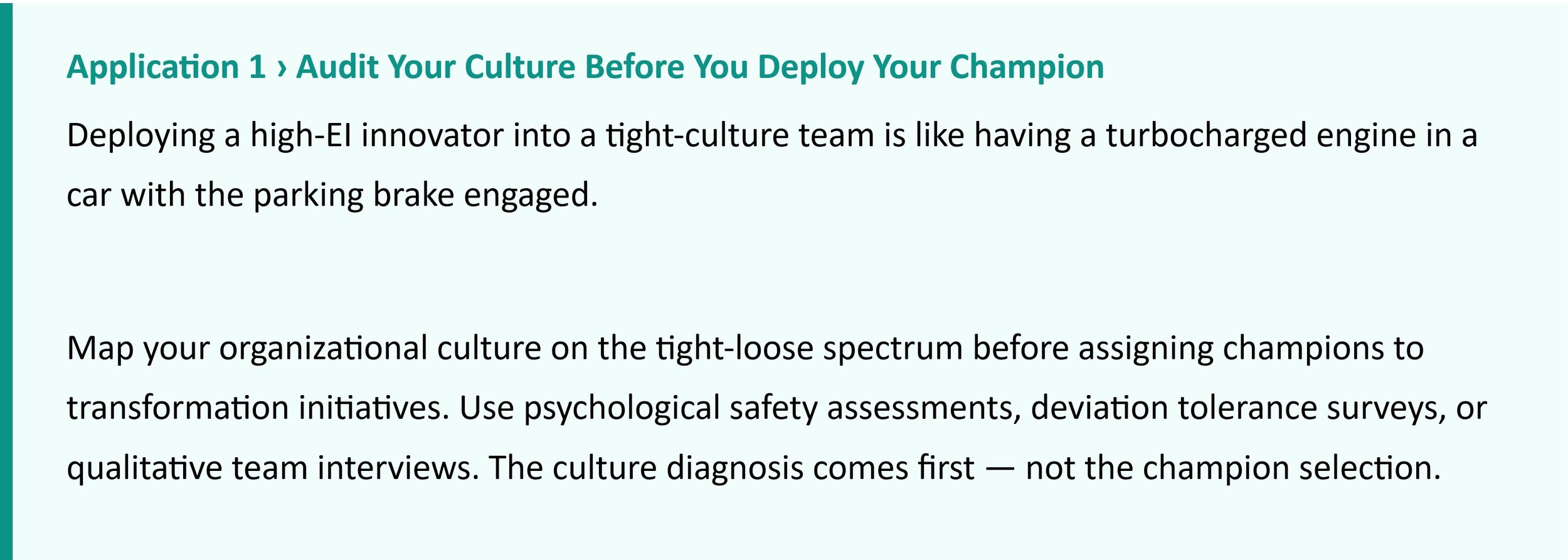
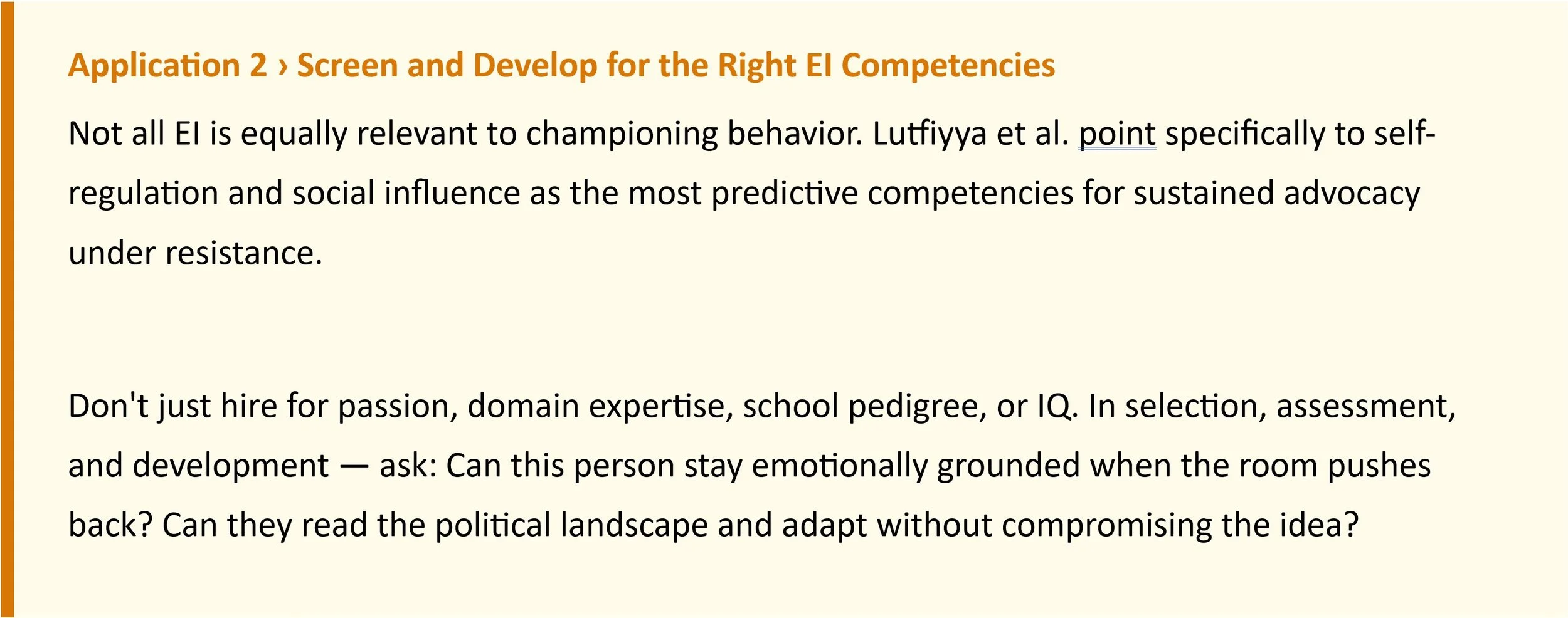
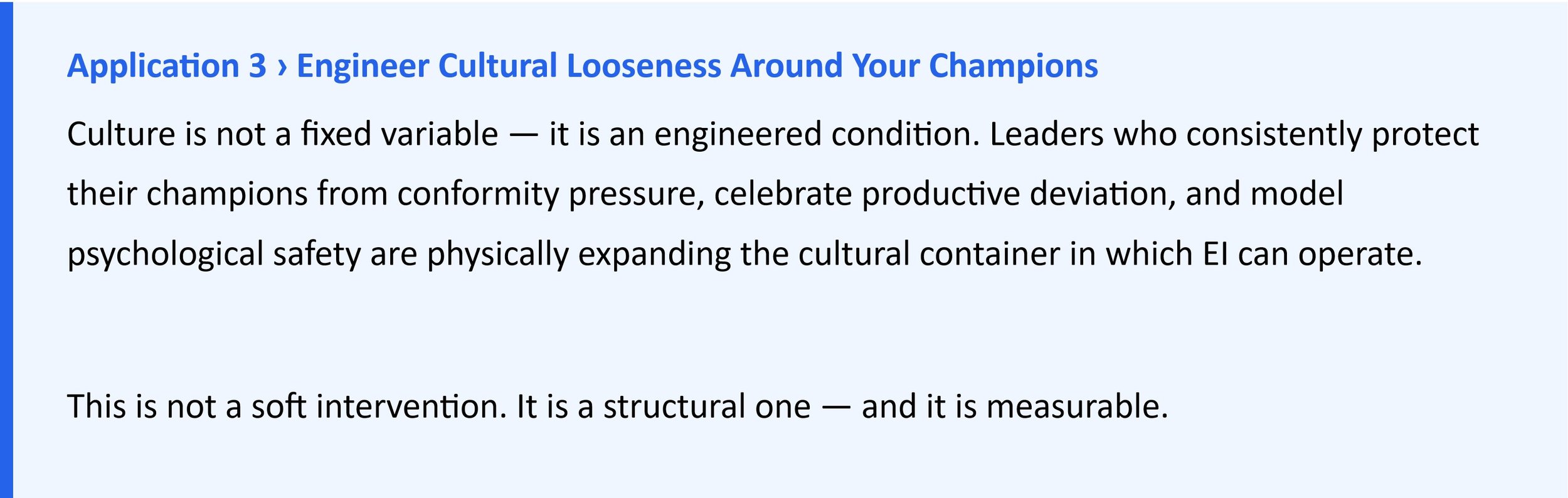
This is where theory meets practice in real-world situations. Here are three decisions you can make before your next leadership meeting.

PART 5 — THE DISCUSSION
The Questions Worth Taking Into Your Next Meeting
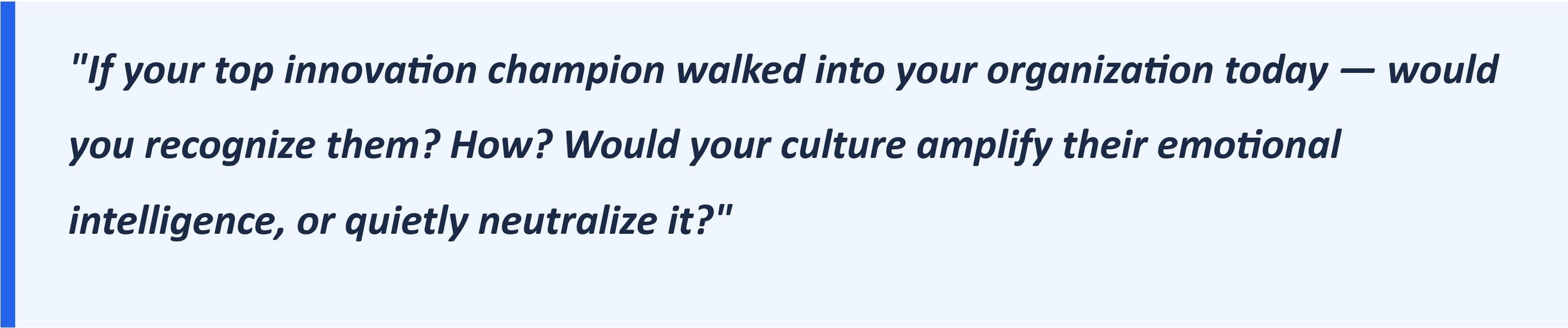
These questions are deceptively diagnostic. Most leaders assume their culture supports innovation because they have said so publicly, or because they have an innovation lab, or because their company values deck includes 'bold thinking.'
But the Lutfiyya et al. research suggests that what actually matters is whether the day-to-day behavioral norms — the real culture, not the stated culture — create the conditions for EI to translate into persistent, courageous idea advocacy.
Drop your answers in my inbox (isaam.lutfiyya@novogenesis.org). I am especially curious to hear from those leading teams across cultures with different norms around hierarchy, deviation, and risk.
Discussion Prompts for Your Team:
Where on the tight-loose spectrum would your direct reports say your team culture sits right now?
Can you name a moment in the last six months when a champion's idea was quietly suppressed — not necessarily by leadership, but by cultural pressure?
What one structural change could you make this quarter to shift the needle toward looseness and how would your team institutionalize that change?
SUPPORTING SOURCES & FURTHER READING
Primary Academic Source: Lutfiyya et al. (2026) — International Journal of Innovation Studies
HBR Anchor Article: Primal Leadership: The Hidden Driver of Great Performance — Goleman, Boyatzis & McKee
MIT Sloan (EI & Leadership): Eight Essential Leadership Tips for 2024 — MIT Sloan Management Review
HBR (EI Foundational Research): What Makes a Leader? — Daniel Goleman, Harvard Business Review
HBR (Group EI & Innovation): Building the Emotional Intelligence of Groups — Druskat & Wolff
MIT Sloan (Psychological Safety → Revenue): Skills Training Links Psychological Safety to Revenue Growth — Per Hugander & Amy Edmondson
Forbes (EI at Work): The Importance of Emotional Intelligence at Work — Alan Price, Forbes
O.C. Tanner (EI & Culture Data): Applied Emotional Intelligence — 2025 Global Culture Report, O.C. Tanner Institute
#EmotionalIntelligence #Innovation #Leadership #OrganizationalCulture #InnovationManagement #EQ #FutureOfWork #BusinessStrategy #Management #PsychologicalSafety #ChangeManagement #GrowthMindset #ResearchToPractice #ThoughtLeadership #LeadershipDevelopment
ABOUT THE RESEARCH
This post is based on the peer-reviewed study "Emotional intelligence as an antecedent to innovation championing behavior and the effects of cultural tightness-looseness" by Isaam Lutfiyya, Yefeng Wang, Soroush Aslani, and K. Praveen Parboteeah, published in the International Journal of Innovation Studies, Volume 10, Issue 1, March 2026, Pages 1–19. All statistics and findings cited are attributed to original published sources. This post is an applied interpretation for practitioner audiences.
ABOUT THE AUTHOR
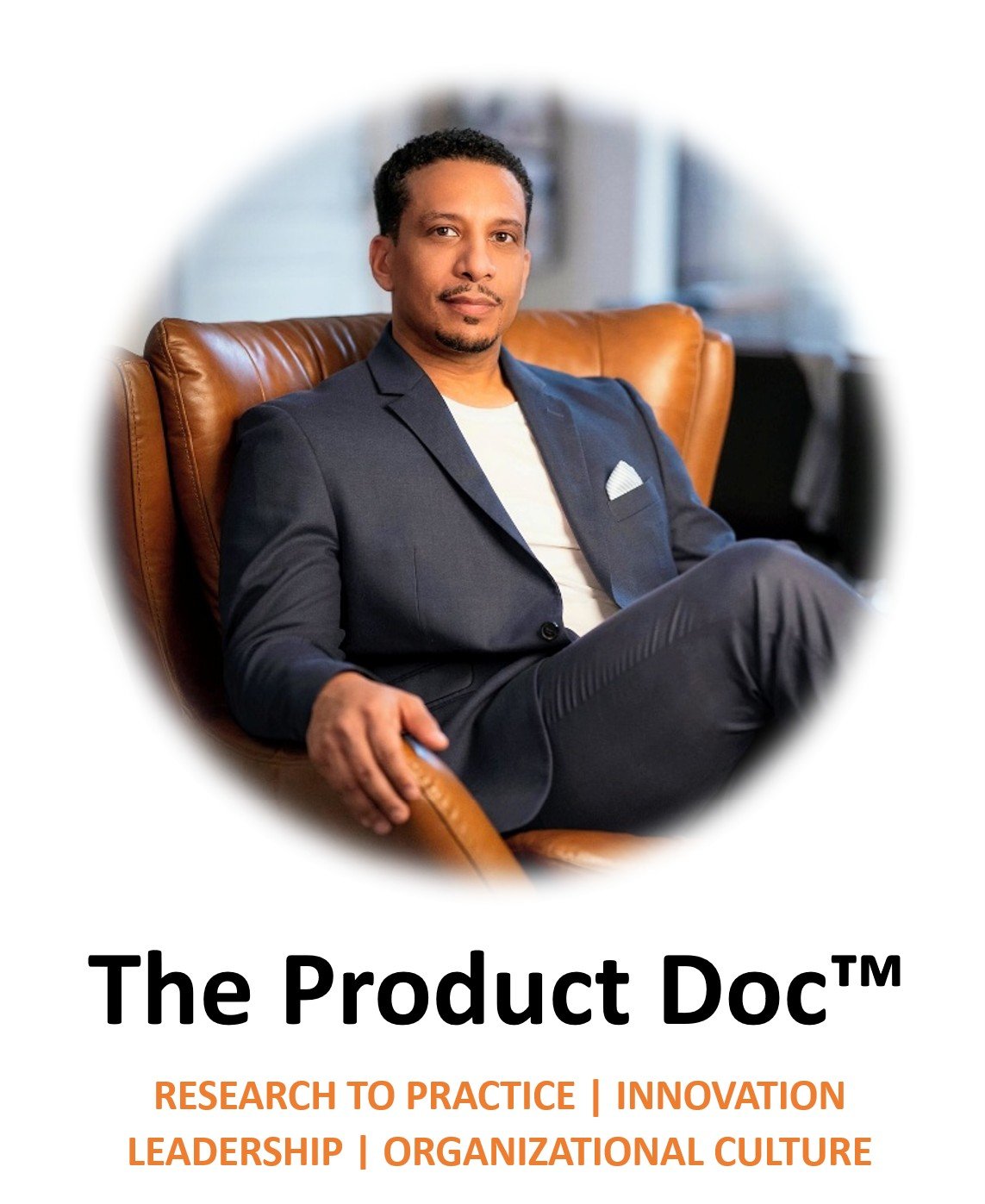
Isaam Lutfiyya, DBA has over 25 years of experience in the Healthcare, Technology and Manufacturing industries. He has held numerous cross-functional and executive-level positions in companies ranging from small, private non-profits to large, multinational F50 companies. He has an MBA and a Doctorate in Business Administration with a concentration in Strategic Management. His expertise and focus – both in research and practice – is on Innovation Strategy, Product Development & Revitalization, Championing Behavior and Development, and applied Emotional Intelligence.
© 2026 Isaam Lutfiyya. All Rights Reserved.